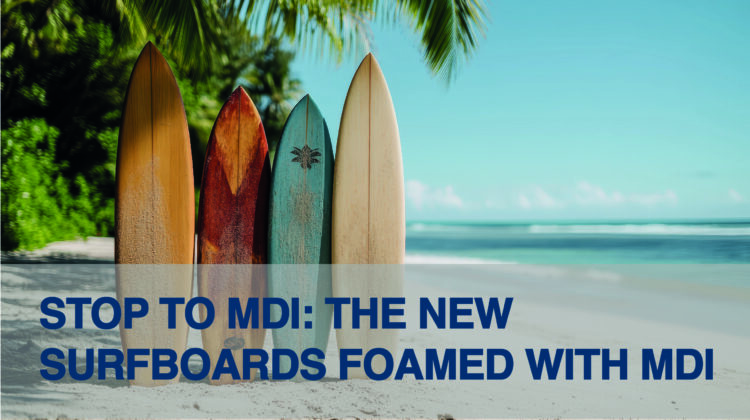
Stop to TDI: The new surfboards foamed with MDI
Il mondo delle tavole da surf sta cambiando, e lo fa nel segno dell’innovazione e della sostenibilità.
This project was born from a specific request from a surfboard manufacturing company, looking for a polyurethane foam that could replace traditional TDI-based systems, known for their greater toxicity for the operator.
The goal?
Develop a new MDI-based system, capable of combining technical performance and greater safety for workers.
Europoliuretani welcomed and shared this project, making available its expertise in the world of polyurethane systems.
The main challenge was to create a polyurethane foam system based on MDI (safer and less toxic than TDI) without compromising the aesthetics and performance of the boards, while maintaining some fundamental characteristics such as the mechanical performance of the foam and the characteristic very white color.
The result
Thanks to constant collaboration and dialogue with the client, the project led to an excellent result: an innovative foam, specifically designed for the surfing sector, which paves the way for a new generation of safer boards.
In this article, we will explain the process and solution proposed by Europoliuretani in using MDI and non-TDI for the development of surfboards, while always maintaining the main characteristics that a surfboard must have.
What is TDI:
TDI, Toluene Diisocyanate, is a chemical used in the production of polyurethane polymers, capable of producing rigid and semi-rigid expanded foams, characterised by particular mechanical performances.
Its use facilitates working in open molds, obtaining a very fine and regular cellular structure even in free casting, essential for the subsequent shaping, smoothing and finally resin-coating operations.
However, TDI is characterised by a non-ideal toxicological profile: TDI is volatile and toxic by inhalation, which is why it is among the substances regulated by the Seveso legislation (included among the hazardous substances listed in Annex I of Legislative Decree 105/2015).
What is MDI:
MDI, Methylene Diisocyanate, is a substance belonging to the isocyanate family, also used in the production of polyurethane composites. However, having a lower vapour pressure, it involves significantly lower inhalation risks than TDI (in fact, it is not among the substances covered by the Seveso law).
The challenge: a super white foam for surfboards
The customer used a TDI-based polyurethane system to create a super-white,
rigid yet flexible foam with very fine cells, ideal for surfboards. Europoliuretani
proposed an innovative solution based on MDI and specific polyols, with the goal of:
- reduce toxicity for the operator,
- obtain a white, compact and light foam,
- ensure excellent mechanical characteristics: hardness, flexibility and workability
A tailored development project
After numerous technical discussions and samples, Europoliuretani’s R&D team has
worked on several variants:
- foams with modified MDI and optical and UV additives,
- prepolymers with different viscosities to optimize workability,
- colored solutions

Tests carried out by the Customer have highlighted significant progress: the boards produced with the new formulations have shown excellent compressive strength, flexibility and ease of workability.
The color has also been perfected thanks to the addition of whitening and anti-UV pastes.
In particular, cell size and uniformity have also been
progressively improved.
Viscosity and reactivity: a winning balance
One of the biggest challenges we encountered was balancing the system’s viscosity to allow for uniform distribution of the compound in the mold. Europoliuretani has
studied several approaches:
- use of prepolymers with medium viscosity,
- modification of MDI to increase its viscosity,
- introduction of rheological additives (to modify the viscosity of the composites).

A more advanced future for surfboards
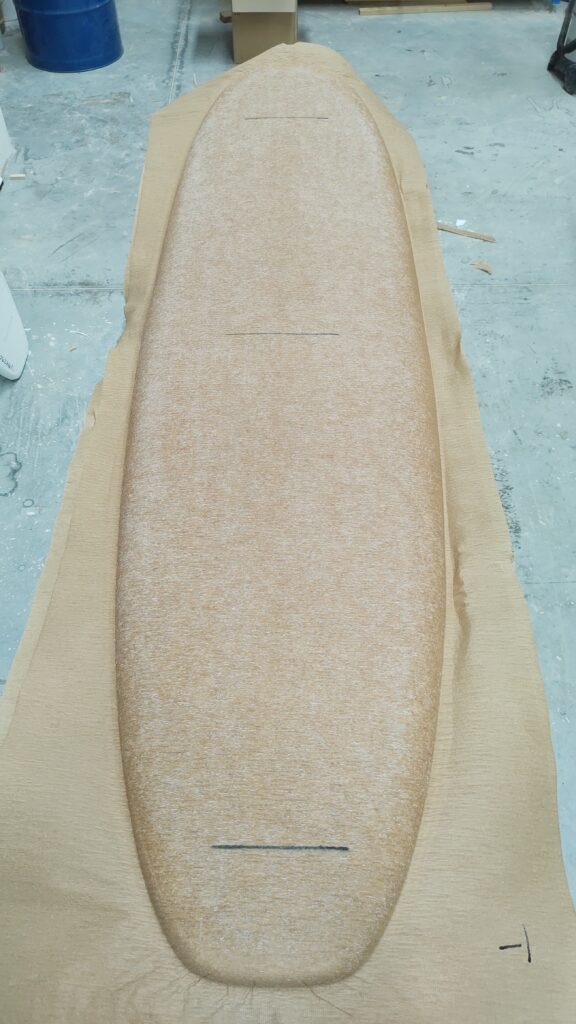
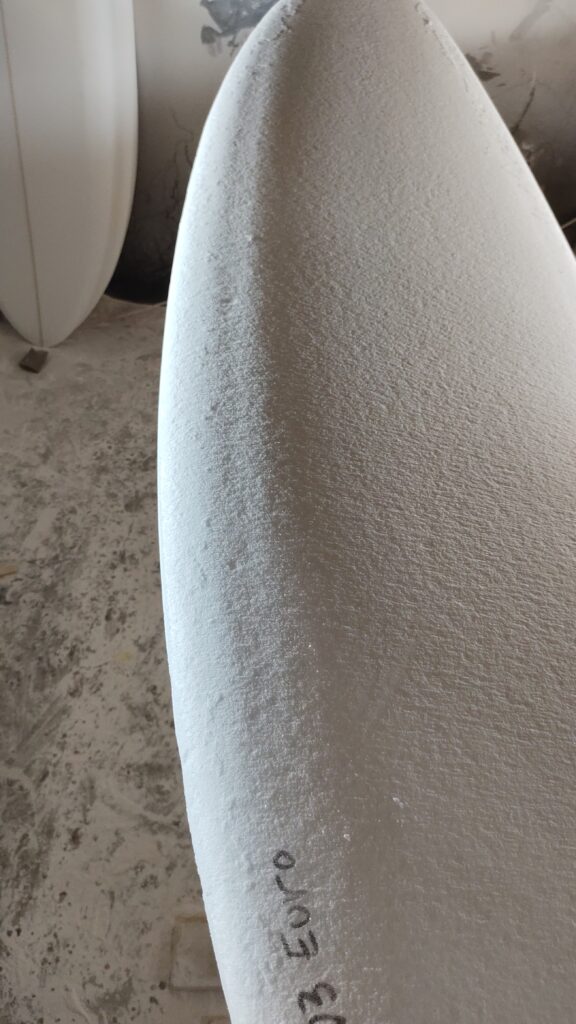
The formulation was developed to provide a polyurethane system suitable for making surfboards, obtaining a foam with fine cellularity, suitable mechanical properties and, above all, a color rendering similar to the main systems currently in use, with the great advantage of using isocyanic components based on MDI rather than TDI; the use of MDI significantly reduces the level of risk to which professional users are exposed, thanks above all to the reduced volatility of the component and its improved toxicological profile compared to TDI.
The formulation has been designed to ensure an optimal mixing level with the polyol part while maintaining a viscosity range that facilitates the deposition of the liquid mix in the mold.
This collaboration demonstrates how chemical research applied to polyurethane can support surfboard companies on the path to a higher-performance product.